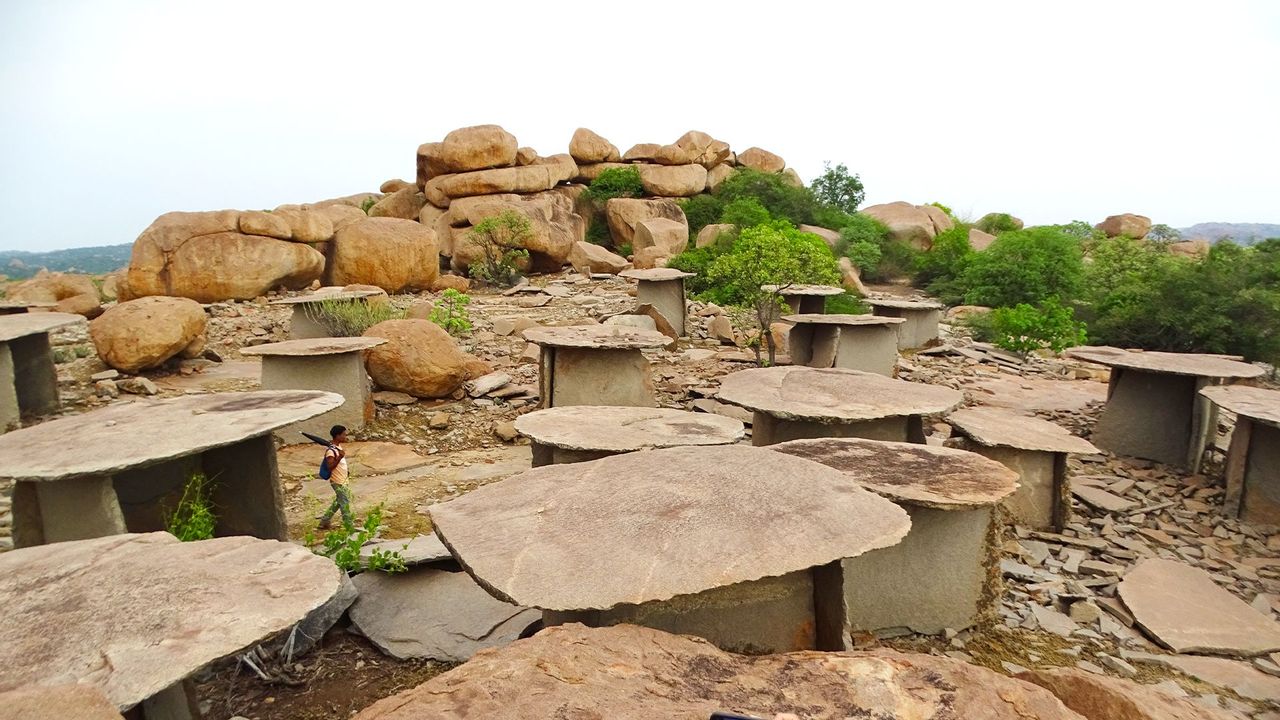

Concealed in several parts of India, especially in the southern region of Tamil Nadu, are ancient stone constructions that intrigue archaeologists, historians, and inquisitive explorers equally. Known commonly as «dwarf chambers» due to their remarkably small size, these structures raise inquiries regarding their intent, originators, and the groups that possibly utilized them. As studies into these enigmatic chambers advance, fresh hypotheses are developing that question our comprehension of India’s long-ago history.
Fascinating architecture and building
At first glance, these tiny chambers seem almost too small to serve any practical function. Most of them are built from megalithic stone slabs—massive pieces of rock that were skillfully shaped and stacked without mortar. The internal height of many of these chambers is often less than four feet, making it impossible for an adult to stand upright inside. Despite their compact size, their construction is remarkably precise, suggesting careful planning and advanced stone-working techniques.Some of the structures are cylindrical or barrel-vaulted in shape, while others follow rectangular layouts. Their entrances are typically very low, requiring anyone entering to crouch significantly. These architectural features indicate that these chambers were not meant for routine habitation. So what were they used for?
Theories on their purpose
There are several theories that attempt to explain the existence of these small stone enclosures. The most common hypothesis is that they were burial chambers or memorial structures. In many megalithic cultures, similar dolmens and cairns were used to honor the dead, and their diminutive size may have had symbolic, rather than functional, importance. Some suggest they were cenotaphs—monuments erected in memory of the deceased, without containing the remains themselves.
Another theory proposes that these chambers served ritualistic or ceremonial functions. In ancient India, sacred spaces were often intentionally designed to alter the physical and mental state of those who entered. The act of bending or crawling into a confined space might have held symbolic significance, perhaps representing humility, rebirth, or communion with ancestral spirits.More speculative interpretations have linked these chambers to esoteric spiritual practices. Some believe they may have been used for isolation or meditation by mystics or sages, offering a physically restricted but spiritually expansive environment. The tight spaces might have encouraged introspection and sensory withdrawal, aligning with the goals of certain ascetic traditions.
Geographic distribution and archaeological patterns
Although these dwarf chambers are most prominently found in Tamil Nadu, similar structures have been discovered in parts of Kerala, Karnataka, and Andhra Pradesh. Their widespread distribution across the southern Deccan Plateau hints at a cultural tradition that may have been more common than previously assumed.What is particularly fascinating is the consistency in style and scale among these chambers, despite being found across different regions.
El texto sugiere que sus constructores podrían haber compartido creencias, costumbres o conocimientos tecnológicos similares, aunque estuvieran separados por distancia o época. En ciertos lugares, estas cámaras se encuentran agrupadas, lo que indica que formaban parte de un paisaje ritual más extenso. Esto plantea interrogantes sobre cómo las comunidades antiguas percibían el espacio, la muerte y la espiritualidad. ¿Servían estas cámaras como un medio para señalar terreno sagrado? ¿Estaban vinculadas a ritos estacionales o reuniones comunitarias? Tales preguntas permanecen abiertas a interpretación, especialmente en ausencia de registros escritos o inscripciones detalladas.
Difficulties in understanding
One of the biggest obstacles to fully understanding the function and significance of these chambers is the limited archaeological data available. Many of the sites have suffered from erosion, vandalism, or development. Some were discovered by accident, while others remain hidden in remote or inaccessible areas. As a result, only a fraction have been systematically studied.Moreover, because the chambers are largely devoid of artifacts—no pottery, bones, or tools—it is difficult to draw definitive conclusions. Their austerity might be intentional, or it might reflect centuries of exposure and looting. Either way, the lack of physical evidence leaves much room for conjecture.Despite these challenges, advances in technology are helping to shed new light on these ancient structures. 3D scanning, ground-penetrating radar, and photogrammetry are increasingly used by researchers to document and analyze sites without disturbing them. These tools allow archaeologists to identify construction techniques, map layouts, and detect subsurface features that might reveal more about their use.
Cultural environment and persistence
India has a long tradition of complex ritual practices, many of which are intertwined with architecture. From ancient cave temples to modern shrines, the connection between space and spirituality is deeply ingrained in the subcontinent’s cultural fabric. The dwarf chambers may be part of this continuum, representing a now-lost expression of belief that was once widely understood and respected.Interestingly, local oral histories and folklore sometimes make reference to «houses of the ancestors» or «spirit dwellings,» which may correspond to these structures. While these accounts are often vague or symbolic, they could offer clues about how these chambers were perceived by earlier generations. In a land where myth and history often intermingle, such narratives should not be dismissed outright.
Conservation and mindfulness
Given their archaeological and cultural value, there is a growing call among scholars and heritage activists to protect these ancient chambers. Many sites remain unmarked and unguarded, vulnerable to neglect or destruction. Raising awareness about their significance could play a crucial role in ensuring their preservation for future study.Educational programs, guided tours, and inclusion in heritage trails are some of the strategies that could help integrate these sites into the broader narrative of Indian history. By doing so, they can be appreciated not only as relics of the past but as living reminders of humanity’s enduring quest to understand the mysteries of life and death.
The dwarf chambers of India represent a captivating and underexplored chapter of ancient history. Their unusual design, enigmatic purpose, and cultural resonance make them valuable subjects of study for anyone interested in archaeology, architecture, or spirituality. As more discoveries come to light and technology aids exploration, there is hope that the secrets held within these small spaces will finally be brought into the light—revealing not just the past, but perhaps something timeless about the human experience.